

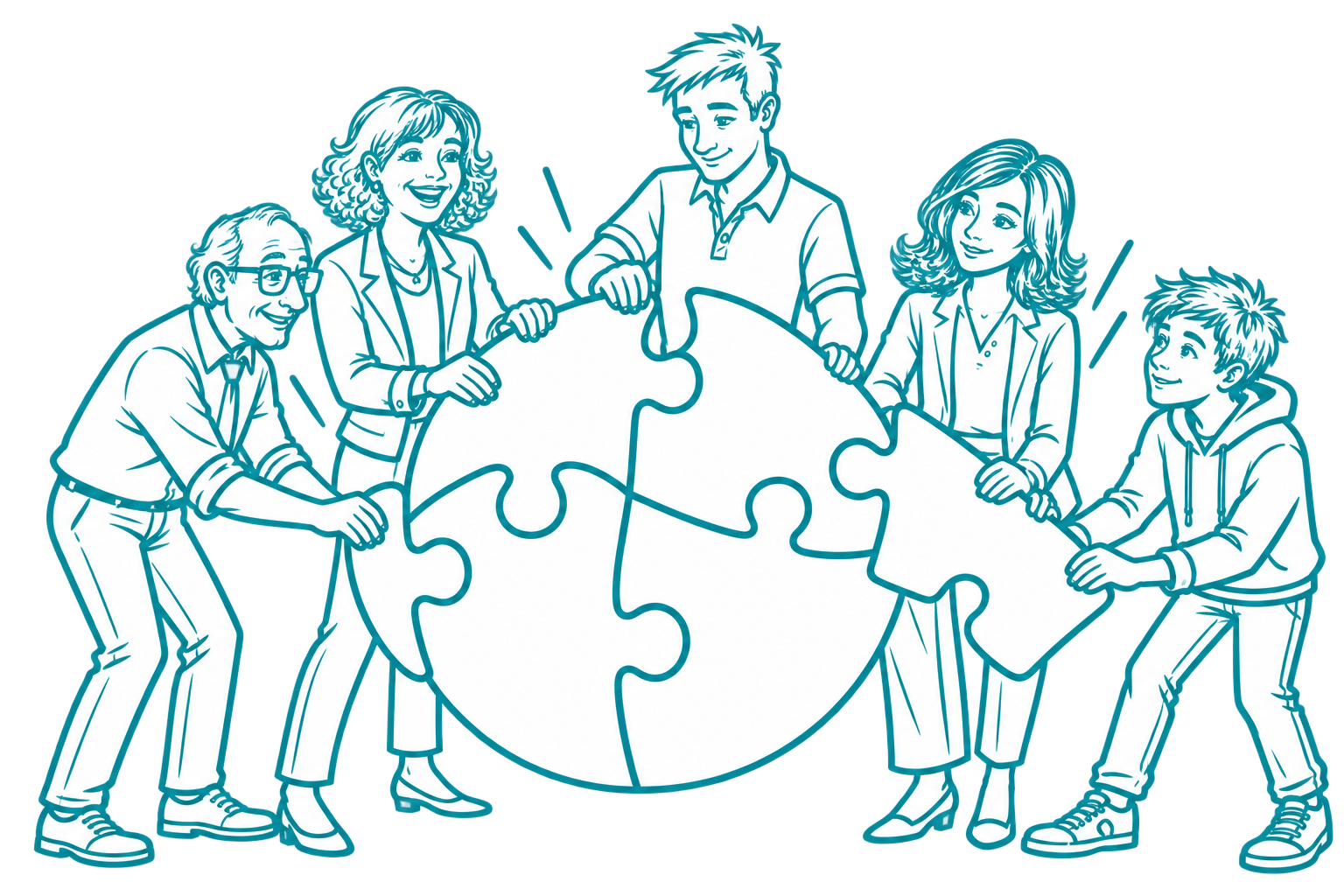
oday’s workplace brings together people who grew up in very different times. They bring different experiences – and potentially different ideas about what good work, good leadership and good collaboration look like.
This diversity becomes particularly interesting in the context of New Work. Because rethinking work is not just about remote work, flexible working hours or modern office concepts.
It raises more fundamental questions:
➡️ How do we want to work together?
➡️ What do people need to take responsibility?
➡️ What creates a sense of belonging?
➡️ How much guidance – and how much freedom – do we need?
➡️ And what do we actually mean by good leadership?
The answers will not be the same for everyone. They are shaped by our personality, our biography and our current stage of life – but also by the time and society we grew up in.
The generational lens offers an interesting way of making these different experiences visible. Not as a label, but as an invitation to change perspective. That is exactly why I see generational diversity as one of the fascinating areas in which New Work takes shape.
Generations have always existed, of course. What is new is something else: today, up to five generations may be working alongside one another in the same organisation.
While Baby Boomers continue to contribute their knowledge and experience, Generation Alpha is already approaching the world of work. The oldest members were born in 2010 and are now reaching an age at which some are beginning vocational training.
In between are Generations X, Y and Z – people whose formative years could hardly have been more different.
Some grew up in a world shaped by economic growth, stability and long-term employment. Others experienced the fall of the Berlin Wall, globalisation and the transition from an analogue to a digital workplace. Others barely remember a world without the internet or smartphones. And the youngest are growing up with artificial intelligence, voice assistants and almost unlimited access to information.
At the same time, the workplace itself is changing at tremendous speed. Digitalisation and AI, demographic change, skills shortages, hybrid collaboration and new ideas about leadership are challenging organisations to rethink how people can work successfully together.
There is one question I find particularly interesting:
What happens when people with such different experiences work, lead, make decisions and navigate change together?
This is where the generational perspective becomes valuable to me. Not because someone’s year of birth explains how they think or behave. But because understanding different formative experiences can help us make sense of different expectations – and sometimes see conflicts in a different light.
A generation is not simply defined by a year of birth. The generational perspective becomes interesting when we look at the times people grew up in: social change, technological developments, crises and periods of optimism – and the opportunities available to them.
There are worlds between the formative experiences of Baby Boomers and those of Generation Alpha: economic growth and social change, the fall of the Berlin Wall and globalisation, the internet and smartphones, the pandemic, the climate crisis and artificial intelligence.
These experiences do not determine who an individual person is. But they may influence the way we think about work:
➡️ What does performance mean to us?
➡️ What do we expect from leadership?
➡️ How do we communicate?
➡️ How important are security and stability – or freedom, flexibility and autonomy?
Before we take a closer look: Definitions and birth-year ranges vary between countries and studies. The ranges used here reflect a primarily German/European perspective and are intended as orientation rather than fixed categories.
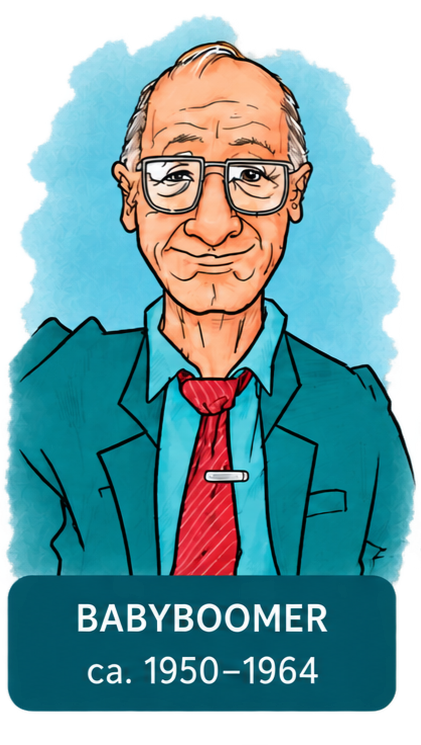
Baby Boomers grew up during a period of economic growth, increasing prosperity and significant social change.
They are often associated with values such as loyalty, a strong sense of duty, commitment, consistency and responsibility.
In today’s workplace, many bring something particularly valuable: decades of experience, established networks and in-depth knowledge of organisations, industries and their development. In the context of demographic change, the question of how to retain and transfer this knowledge is becoming increasingly important.
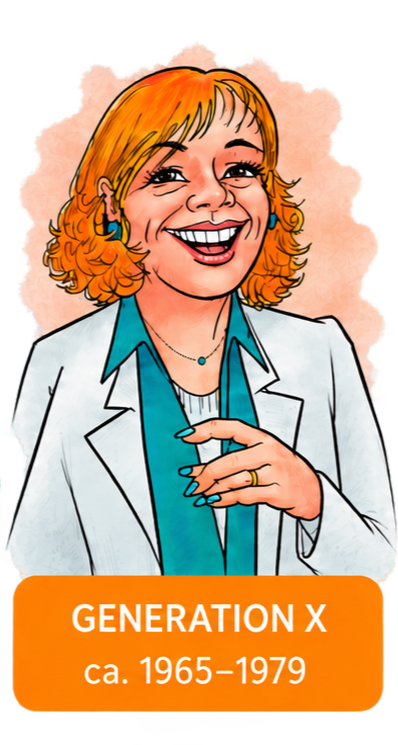
An analogue childhood, a digital transformation. Generation X experienced the fall of the Berlin Wall, globalisation and rapid technological change – and actively participated in the transition towards an increasingly digital workplace.
They are often associated with self-reliance, pragmatism, independence, flexibility and a solution-oriented mindset.
Today, this can allow them to act as an important bridge between different worlds of work. They are familiar with traditional structures as well as digitalisation and new forms of collaboration – and have already experienced and helped shape considerable change themselves.
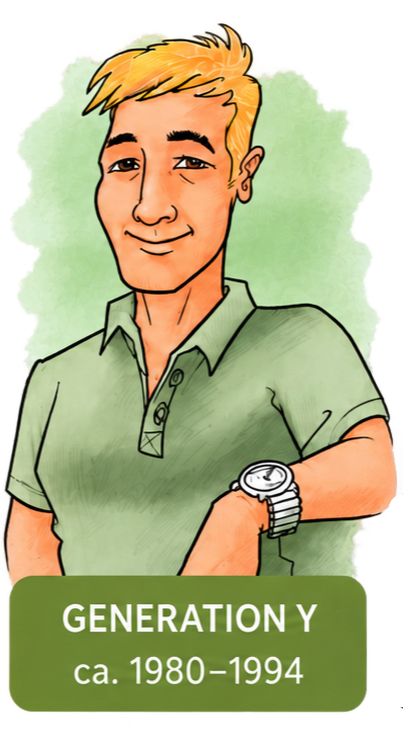
The so-called Millennials came of age with the internet, globalisation and new ways of working. It is no coincidence that this generation is often associated with the question “Why?” - Meaning, personal development, participation, feedback and collaboration on equal terms feature prominently in descriptions of this generation.
With their openness to new ways of working, Generation Y has helped drive greater flexibility in the workplace – from start-up and innovation culture to more agile forms of collaboration, greater participation and self-organisation.
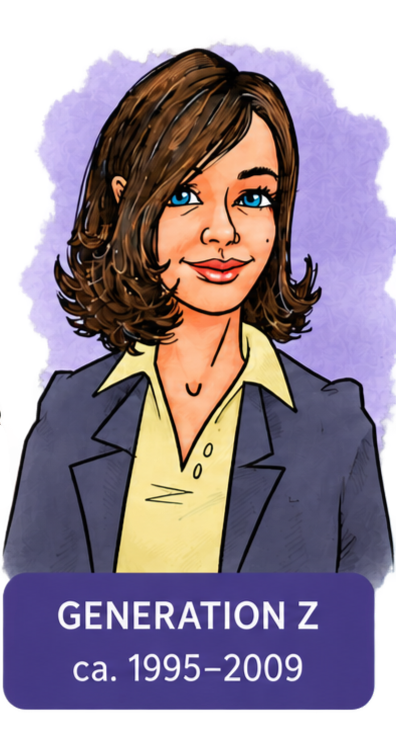
Digital natives – but not disconnected from the analogue world. Smartphones, social media and constant connectivity are as much a part of their experience as global crises, climate change and a rapidly changing world. Gen Z is often associated with authenticity, diversity, transparency, autonomy, health and work-life balance.
Their perspective on work challenges some assumptions that were taken for granted for a long time – such as permanent availability, rigid career paths or the idea that physical presence automatically says something about performance.
In doing so, Gen Z is contributing important impulses to a workplace in which performance, flexibility and a healthy approach to personal resources are being renegotiated.
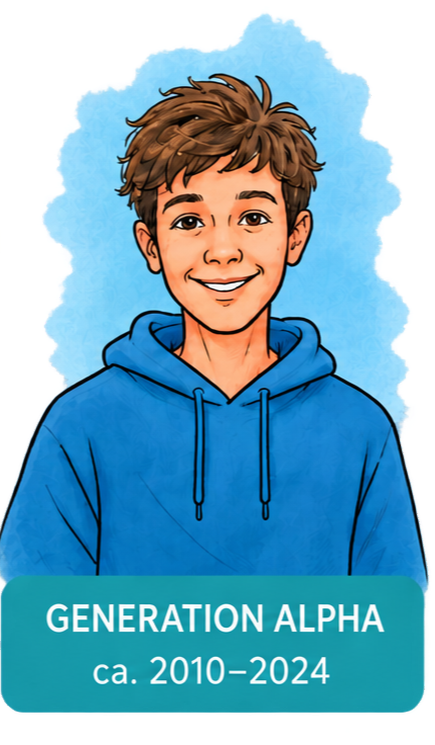
Generation Alpha is the first generation growing up in a world where AI, voice assistants, streaming and almost unlimited access to information have been part of everyday life from childhood.
We cannot yet reliably predict which values they will develop or what they will expect from work and leadership. Their perspective on learning, knowledge and technology, however, is likely to be shaped by experiences that differ significantly from those of previous generations.
What will they contribute to the workplace? We simply don't know yet.
And perhaps that is exactly what makes them so interesting: the first members of Generation Alpha are approaching the world of work – where they will meet four generations who grew up under very different technological and social conditions.
No one is a “typical Baby Boomer”, a “typical Gen Xer” or a “typical Gen Zer”. We are all shaped by our personality, our family, our social environment, our individual experiences – and the stage of life we currently find ourselves in.
So why talk about generations at all?
Almost 100 years ago, sociologist Karl Mannheim described how shared social and historical experiences – particularly during our formative years – can create common generational influences. These experiences may affect the values we develop, the way we communicate, what we expect from leadership or how we experience collaboration.
For me, the generational hypothesis is therefore not a label, but a lens for changing perspective.
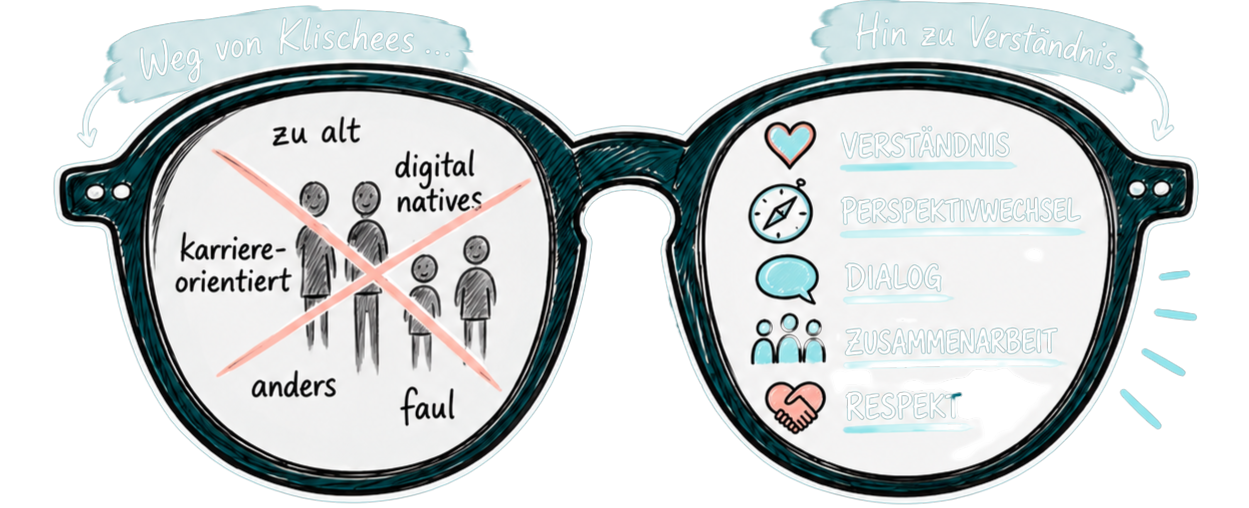
It does not explain why an individual person is the way they are. But it can make us curious:
➡️ What experiences have shaped the person I am working with?
➡️ What expectations might have emerged from those experiences?
➡️ And which of my own assumptions about “good work” do I simply take for granted?
Things become particularly interesting when these different perspectives meet in everyday working life. When ideas about good communication, performance, leadership or commitment differ, misunderstandings can quickly arise – and sometimes conflict.
The generational perspective can then help us take a step back and understand the other person’s point of view.
In my work with leaders and teams, I regularly encounter situations in which different ideas about how collaboration is “supposed” to work collide:
➡️ How directly do we communicate?
➡️ How much feedback do we need?
➡️ What does commitment mean?
➡️ How much guidance do we expect from a leader – and when does leadership start to feel like control?
➡️ How important are physical presence, flexibility, security or autonomy?
Not every difference is a generational issue. But sometimes, a generational perspective opens up a new way of looking at something that previously seemed primarily like a personal difference – or even a conflict.
In Business Coaching
In Business Coaching, the generational lens can provide an additional perspective for reflection.
➡️ What is my own idea of good leadership?
➡️ What does performance mean to me?
➡️ Which expectations around communication or commitment do I take for granted – and why?
For leaders in particular, it can be useful to understand that the same leadership behaviour may be experienced very differently by different people. What feels like clear guidance to one person may feel like control to another. What one person experiences as freedom may feel like a lack of support to someone else.
In Team Development
In multigenerational teams, I use the generational perspective to make differences visible and discussable before they turn into assumptions about one another.
For example, I work with fictional personas and interactive formats. They allow teams to explore different experiences and expectations from a little distance first – before making the connection to their own team:
➡️ What do we recognise in our own team?
➡️ Where do our expectations differ?
➡️ What can we learn from one another?
➡️ And how do we want to work together?
In Mediation
The generational perspective can also be useful when dealing with conflict. Not as a way of quickly labelling something a “generational conflict”, but as a means of exploring other possible reasons for different perceptions and expectations.
Perhaps a disagreement about working from home is not really just about physical presence. Perhaps a conflict about feedback is not simply about tone. And perhaps a discussion about availability is not only about commitment.
Exploring what has shaped us can help us move away from judgement – and become curious again about the other person’s perspective.
Five generations within one organisation mean different experiences and different perspectives – and an enormous diversity of knowledge, ideas and possibilities.
For me, the crucial question is therefore not which generation will shape the future of work. The far more interesting question is how we can shape that future together.
We do not need to minimise our differences, nor do we need to overstate them. Instead, we can use them as a starting point for conversation: about what matters to us, about our ideas of good work and about what we can learn from one another.
This is where I see the real potential of multigenerational collaboration: experience meets new ideas. Established knowledge meets new perspectives. Stability meets a willingness to change.Not as opposites, but as different resources for a shared future.
Perhaps that shift in perspective starts with one simple question: What has shaped you?
Because the generational lens does not explain people. But it can make us curious about one another.


