Few generations have sparked as much debate in the workplace as Gen Z.
They want flexibility and security. Remote work and a sense of belonging. They expect to be treated as equals, while still looking to leaders for clarity and direction. They want feedback, yet sometimes struggle with commitment. They have instant access to more information than any generation before them – and still need to learn how to turn information into expertise.
Contradictory? Only at first glance.

GEN Z BRINGS THEIR WHOLE SELF TO WORK.
AND THEY EXPECT THE WORKPLACE TO SEE MORE THAN JUST THE EMPLOYEE.
Gen Z has grown up in a world that is full of contradictions itself: almost unlimited possibilities combined with profound uncertainty. Constant digital connection alongside the experience of social distancing. Information available at any time – and a level of complexity that makes orientation all the more important.
All of this shapes what Gen Z expects when they enter the workplace. And there, they encounter structures, leadership cultures and ideas about work that often come from a very different era. No wonder there is friction. And that friction is already changing the workplace.
These are some of the patterns I see in my work with organisations – and some hypotheses I think are worth exploring.
Definitions vary, but Generation Z generally refers to those born between 1995 and 2009. We could spend a lot of time debating the exact cut-off dates. I’m not sure it would get us very far. Nobody suddenly became Gen Z on 1 January 1995.
Generations are not boxes. They are a way of describing shared experiences. People born around the same time encounter social, technological and political changes at similar stages of life – and those experiences can shape how they approach work, leadership and collaboration.
If you are interested in this broader perspective – and in what happens when Baby Boomers, Gen X, Gen Y, Gen Z and Gen Alpha work side by side – you can read more in my article “5 Generations in the Workplace.”Here, I want to zoom in on Gen Z.
Because the world that shaped them is unlike anything previous generations grew up with.
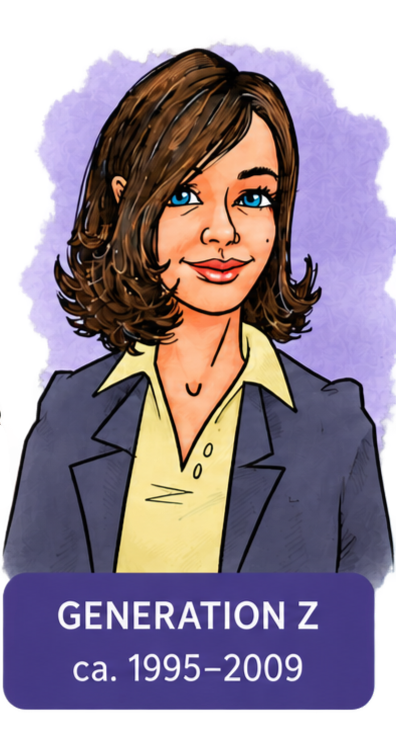
Gen Z is the first generation for whom a digitally connected world has been a given from an early age.Information is always available. Communication happens in real time. Geographical boundaries matter less in everyday life. Many have travelled internationally from a young age, watch films and series in their original language and move naturally between international communities. For many, English is simply part of everyday life.
At the same time, the number of choices has exploded. University or vocational training? A year abroad? Start-up or corporation? Career, self-employment, sabbatical or workation? Munich, Berlin or Lisbon?
That is freedom. But having endless options can also be exhausting.
When almost anything seems possible, every decision also means turning down countless alternatives. And social media keeps those alternatives permanently visible: other jobs, other places, other lifestyles, other people apparently living a more exciting life.
There is always another option. FOMO – the Fear of Missing Out – fits this world remarkably well. I see some of that reflected at work. Making decisions can be difficult. Commitment can feel harder when another possibility is always just one swipe away. At the same time, the need for clarity and orientation grows.
That makes sense to me: The more possibilities there are, the more valuable a reliable framework becomes.
And all those possibilities have been accompanied by a remarkable concentration of uncertainty: climate change, the pandemic and social distancing, war in Europe, economic instability. Now AI is accelerating technological change once again.
The future feels wide open – and anything but predictable.Against that backdrop, one aspect of Gen Z is easily overlooked:They want security.
And that brings us to one of the tensions I find most interesting about this generation.
Gen Z wants security. But flexibility is equally non-negotiable: flexibility around working hours, location, career paths and how work fits into life. To me, that isn't a contradiction at all.
I like to think of agility as a dial between two poles: stability and flexibility: Too much stability creates rigidity. Too much flexibility creates disorientation. What we need depends on the situation – and the dial has to move accordingly.
That is exactly what I find interesting about Gen Z. Security does not necessarily mean sitting at the same desk every day or following a predefined career path for the next twenty years. Security can come from clear structures. Reliable relationships. Transparent decisions. Leaders who provide orientation.
Within that framework, there can be a great deal of flexibility.

Agility, New Work, virtual collaboration, hybrid teams, flexible working hours – none of these ideas came from Gen Z. For years, organisations have experimented with agile structures, new forms of leadership, self-organisation and flexible work. And, at the latest during the pandemic, we proved that work does not necessarily have to happen in one fixed place.
Now a generation is entering the workplace for whom much of this is no longer new work. It is simply work. And more importantly: They expect us to deliver on it. That is where the real test begins.
Flexibility looks great in a company’s values. It becomes more challenging when employees actually want to decide where and when they work. Leadership based on mutual respect gets broad approval – until a 25-year-old questions a decision. Agility sounds appealing – until self-organisation starts challenging established hierarchies.
Gen Z takes us at our word.
They are entering organisations that have spent years talking about flexibility, self-organisation, digitalisation and collaborative leadership. And they ask the obvious question: If we believe in all of this, why aren't we actually doing it?
That can be uncomfortable. But it also reveals which parts of our “new world of work” have genuinely changed organisations – and which parts may have remained little more than good intentions.
In that sense, Gen Z fits surprisingly well with what we have been calling agility for years. They did not invent it. They are putting it to the test. And in doing so, they also reveal something else: Flexibility alone does not make a good workplace. Being able to work from anywhere is one thing. Feeling that you belong is another.
Gen Z values flexibility. At the same time, I see a strong need for belonging among many young people. They want to be part of a team. They want connection. They want relationships.
I have two hypotheses about where this comes from.
The first is the pandemic. For many Gen Zers, Covid hit at a formative stage of life: school, university, vocational training, first jobs, friendships, parties, travel – all the things that normally involve being with other people. For a while, social distancing became normal. I can well imagine that this sharpened their awareness of something very basic: how much real human connection matters.
My second hypothesis is about family. Many members of Gen Z have grown up with close relationships to their parents. Parenting has become more collaborative. Parents are people to talk to, confide in and sometimes almost be friends with. That closeness often continues into young adulthood. Many stay at home longer, too. Of course, high rents, longer periods of education and financial pressures are part of the picture. But I don't think they explain everything. Staying close to your family as a young adult has simply become more normal.
Independence no longer requires distance.
And I see a similar pattern at work: a desire for freedom and flexibility alongside a strong need for connection.That creates a real challenge for organisations.Flexible work creates freedom. It does not automatically create belonging.Belonging needs relationships. Shared experiences. Time together.
A Teams channel doesn't make a team.
Gen Z wants the flexibility that organisations have spent years creating. At the same time, they remind us that work is also a social space. How we reconcile those two things in virtual and hybrid workplaces is a topic in its own right – and one I explore in more detail in my articles on virtual collaboration and hybrid teams.
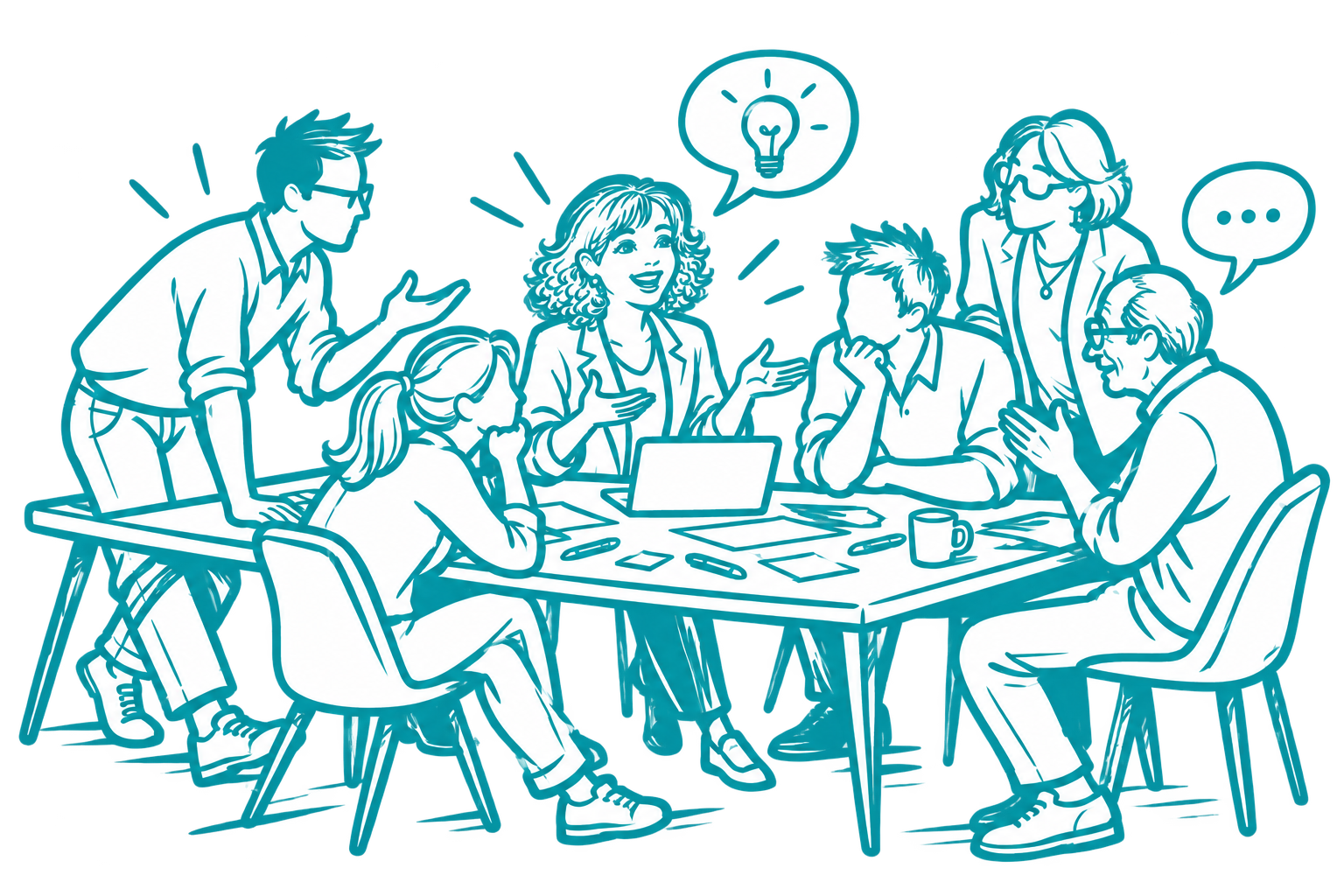

Gen Z questions hierarchy. They expect to be taken seriously. They speak up. They want to understand decisions rather than simply accept them. That can be challenging – particularly for leaders who entered the workplace under very different conditions. But it is worth asking who raised these young people.
Many Gen Zers were raised by Gen X parents. And Gen X wanted to do quite a few things differently. Children were encouraged to have an opinion. Decisions were explained. Feelings and needs were taken more seriously. Having a say became normal. Parenting became more collaborative. We taught our children to ask questions, stand up for themselves and not assume that adults are right simply because they are adults.
And now those children are joining our organisations. Of course they do not suddenly accept a decision without question simply because it comes from someone with a more senior job title. They want to understand it. They want to discuss it. They want to be taken seriously. And they expect their perspective to matter – even if they have only been with the company for six months.
Dear Gen X: You raised them this way. And I don't mean that as criticism. Quite the opposite. We wanted confident young people who could think for themselves and communicate as equals. Now we are seeing what that means at work.It changes leadership. A job title alone is becoming less effective as a source of authority. Leadership has to earn trust through competence, clarity, reliability and relationships. That does not make leadership less important.If anything, a generation faced with so many choices has a strong need for orientation. Decisions still have to be made. Boundaries still matter. Expectations need to be clear.
Treating people as equals doesn't mean leaving them without direction. For me, that is one of the central leadership challenges: provide clarity, take responsibility and offer orientation – without making people feel small.
Gen Z asks for feedback. Regularly. Quickly. And far more naturally than many generations before them. This is sometimes dismissed as a need for constant validation. I think that misses the point. Baby Boomers, Gen X and Gen Y wanted to know whether they were doing a good job too. They wanted to know where they stood and how they could improve. Many simply learned to live with a work culture that was remarkably economical with feedback. An annual appraisal. Maybe another conversation after the probation period. And in between? No news is good news.
Gen Z is less willing to accept that. Again, their experience outside work matters. If you grow up with social media, feedback is constant. Posts get likes, comments and reactions. Messages are read, answered – or visibly left unanswered. You know almost instantly whether something creates a response.
Feedback is fast. And it is everywhere. It seems entirely plausible to me that this shapes expectations at work as well. In that world, waiting twelve months for a formal performance review feels rather outdated. And feedback is not the same as praise. It provides orientation. It helps people learn. It makes expectations visible. It tells us what is working and what needs to change. It also goes both ways. If you expect to be treated as an equal, you do not just want to receive feedback. You expect to be able to give it too.
That can take some getting used to – particularly for leaders who grew up in organisations where feedback travelled mainly from the top down, and often only when something had gone wrong. A good feedback culture does not mean telling people how wonderful they are all day. It means staying in conversation. Recognising good work. Addressing problems early. Being clear about expectations. Reflecting on development together. And being able to take feedback – on both sides.
Gen Z makes something visible here that matters far beyond one generation: People need resonance.
The desire for feedback is closely connected to something else I see in Gen Z: They want to develop.
Coaching, mentoring and personal reflection seem far more normal to many young people than they did to previous generations. The same applies to therapy and psychological support. Asking for help, reflecting on your own patterns or talking about stress, boundaries and uncertainty carries less stigma. That changes the role of coaching too. Young people bring questions about stress and work-life balance, but also questions about meaning, decisions, identity and finding their own path. And the line between “professional” and “personal” is not always particularly clear.
Why should it be? Gen Z brings their whole self to work. They expect to be seen as people, not simply as employees – people with values, needs, boundaries and a life beyond work.
And there is another dimension to development: finding your place within a team. If belonging matters, team development matters too. Gen Z does not simply want to be on an organisational chart. They want to experience what it means to be part of a team. Does my contribution matter? What is my role? What is expected of me? Where can I make decisions? Where can I shape things? Can I disagree?
This is where psychological safety becomes crucial. People who are expected to contribute ideas, take responsibility and speak up need an environment where questions, doubts, mistakes and disagreement are genuinely allowed. Participation doesn't work if people are invited to speak – as long as they don't say anything uncomfortable.
And this is also why I see so much value in interactive and participatory team development: working on real questions together, experimenting, discussing, building with LEGO, going outdoors, laughing, getting away from everyday routines and actually experiencing each other as people. Because Gen Z wants more than membership. They want to belong. They want to know their place. And they want to have a say in shaping it.
For employers, this matters. Salary and flexible working conditions alone do not create commitment. A workplace where people can develop, where coaching is normal and where teams actively invest in how they work together can be a powerful reason to join an organisation – and to stay. Development can become a genuine employer differentiator. Not as another perk. As an experience: I can grow here. I am seen. I belong. And I can make a difference.
Gen Z has also grown up with a different communication style. WhatsApp. Chats. Social media. Short messages. Communication is immediate, informal and often very concise. At work, that can be irritating. An email without a greeting. A two-line message where someone else might have written a carefully worded email. A blunt “Can you send me that?” with no “please”, no sign-off, no softening around the edges. Or a message to a senior leader written in exactly the same tone they would use with a colleague. It can sound impolite. Sometimes even rude or disrespectful.
But different communication codes are colliding here. Someone who has grown up communicating quickly and informally may not associate respect with the same linguistic conventions as someone who started their career twenty or thirty years earlier. And someone who has been raised to see adults as equals does not automatically switch into a more deferential mode just because the person on the other side of the conversation has a more senior title.
That doesn't mean anything goes. Respect still matters. Gen Z, like everyone else, has to learn that intention and impact are not the same thing. What feels perfectly neutral to the sender can land very differently with the person receiving it.
But organisations can ask themselves a question too: Which of our communication rules are genuinely about respect – and which are simply conventions we have learned to interpret as respectful? Because when a short message feels disrespectful, it is worth looking twice.
Is the respect missing – or just the form in which we are used to recognising it?

Gen Z has grown up with almost unlimited access to information. A question comes up, and the answer is seconds away. First Google and YouTube. Now ChatGPT and other AI tools. Tutorials for almost anything. Specialist knowledge available around the clock.
This has created a real strength: Gen Z is remarkably good at finding information quickly and getting up to speed on new topics. But I also see something else – and I am deliberately going to put this provocatively: Sometimes Gen Z seems to know a little about an extraordinary number of things – but a lot about fewer of them.
That would hardly be surprising. If information is always available, there is less reason to store everything in your own head. The ability to find the right information at the right moment becomes a skill in its own right. At work, however, there comes a point when finding information is not enough. Finding something isn't the same as knowing it. Explaining something isn't the same as understanding it. And understanding something isn't the same as experience.
Expertise takes time. It grows through application and repetition. Through getting things wrong. Through recognising patterns that only become visible after years of working with a subject. Through situations where the quick answer turns out not to be the right one. And through experience that cannot be googled – or prompted.
This is one of the places where I see enormous potential in multigenerational teams. Gen Z brings speed, digital fluency, access to information and new ways of solving problems.More experienced colleagues often bring context, judgement and knowledge built up over years. Neither makes the other obsolete. And AI is making that combination even more important. When answers can be generated in seconds, expertise increasingly lies in knowing what to ask, what to trust, what to challenge and how to put an answer into context. That is not only a Gen Z issue. But Gen Z is entering the workplace at exactly the moment when our relationship with knowledge is changing fundamentally.
Organisations therefore need to do more than transfer knowledge to younger employees. They need to create opportunities to turn information into knowledge, knowledge into experience – and experience into expertise.
Flexibility and security. Belonging and freedom. Equality and orientation. Speed and reliability. Endless possibilities – and the desire to know where you stand.
At first glance, Gen Z can seem full of contradictions. Look at the world that shaped them, and those contradictions start to make a lot more sense. They bring them into our organisations. They question rules that other generations accepted without much discussion. They expect feedback. They want a voice. They take flexibility seriously. They want to develop. They expect to be treated as people. And hierarchy alone does not impress them very much.
That can be demanding.
And Gen Z has things to learn too. Collaboration requires compromise. Freedom comes with responsibility. Reliability is not an outdated virtue. Expertise takes time. And being treated as an equal does not mean always getting your own way.
But Gen Z is also holding up a very useful mirror. They did not invent good leadership, feedback, flexibility, participation or personal development. The generations before them have spent years talking about these things, developing new concepts and promising a different world of work.
Gen Z simply expects to find that world when they arrive. Gen Z takes us at our word.